
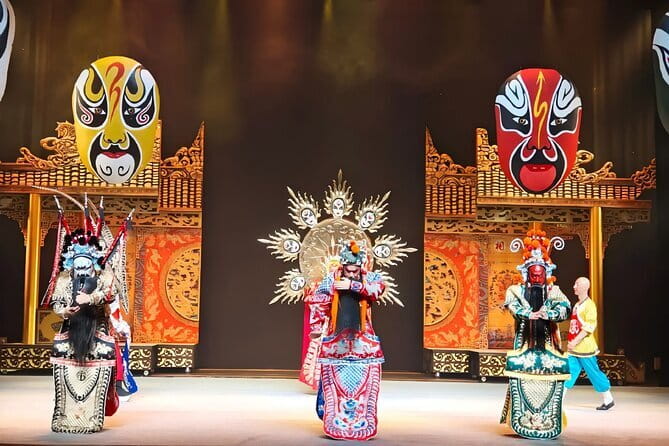
REVIEW · CHINA
Jinjiang Theater: Eight-Face Changing-Legendary Sichuan Opera
The fastest way to understand Sichuan opera is to watch a face change happen before you can work out how it happened. This 70-minute Jinjiang Theater show builds toward an eight-face finale, but it also gives you fire breathing, martial arts, puppetry, acrobatics, and elegant dance for $18.
I like the mix of spectacle and tradition, especially the Little Sanqing story, which gives the evening a human thread instead of presenting one trick after another. I also like the free cup of Sichuan gaiwan tea, a small touch that makes the theater setting feel more rooted in Chengdu.
The main consideration is the pace. With many short acts packed into just over an hour, the show favors quick thrills over long dramatic scenes. If you want a fully translated opera with a slow, detailed plot, this may feel more like a cultural showcase.
Key points to know
- Eight-face changing: The signature act builds on Sichuan opera’s famous rapid mask and face changes.
- Many traditions in one sitting: Expect opera excerpts, hand shadows, puppetry, martial arts, acrobatics, dance, and a fashion presentation.
- Little Sanqing’s story: The performance follows a young artist’s difficult path toward mastering face-changing.
- A strong $18 value: The ticket covers the full approximately 1-hour-10-minute program and includes gaiwan tea.
- Easy evening timing: The show begins at 8pm at Jinjiang Theater near Tianfu Square and public transportation.
- Best for variety: Families, first-time opera viewers, and anyone wanting a compact Chengdu cultural night will get the most from it.
Why this Chengdu show works for first-time opera viewers
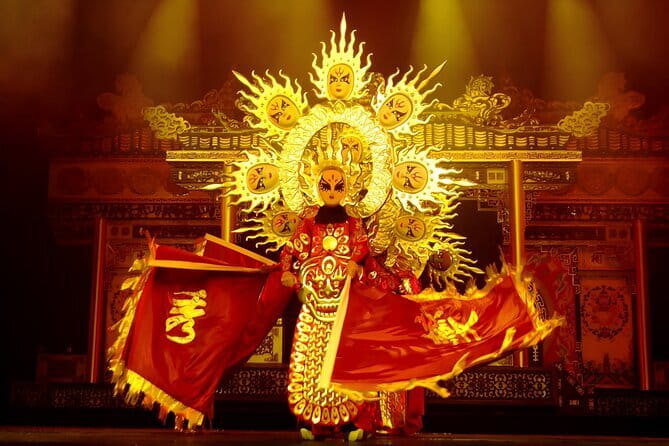
Sichuan opera can seem difficult to approach if you expect a long play with a plot you must follow word by word. This program takes a friendlier route. It gives you recognizable pieces of the art form, then adds physical acts that communicate without much explanation.
The evening is built around Little Sanqing, whose path toward mastering face-changing includes adversity and persistence. That story matters because it frames the final technique as an achievement, not just a magic trick. You get a glimpse of the discipline behind the show while still enjoying the quick surprises that make Sichuan opera so popular.
The format also helps if you have only one evening in Chengdu. At around 70 minutes, it does not take over your night. You can attend the 8pm performance, enjoy the tea, and still leave with time for a late meal or a walk near Tianfu Square.
The tradeoff is that the program moves quickly. Several acts are short specialties rather than fully developed scenes. I see that as a strength for a first visit, but anyone hoping to study traditional opera singing in detail should set expectations accordingly.
More Chinese Opera Shows in Chengdu:
- Chengdu: Sichuan Opera Shu Feng Yan Yun Evening Show Ticket
★ 4.7 · 185 reviews - Chengdu Sichuan Opera Show Ticket – Shu Feng Ya Yun
★ 4.4 · 73 reviews - Chengdu: Sichuan Opera Show Ticket – Shu Feng Ya Yun
★ 4.8 · 30 reviews
Jinjiang Theater and the practical shape of the evening
The performance takes place at Jinjiang Theater, at 54 Hua Xing Zheng Jie in the Luomashi area of Chengdu, near Tianfu Square. The venue is close to public transportation, which is useful for an evening event with a fixed start time.
Your ticket redemption point is the theater itself, and the listed start time is 8pm. Plan to arrive with enough time to find the entrance and collect your ticket without rushing. No meeting with a guide is listed, and no guide names are provided, so this is best understood as a theater performance rather than a guided walking tour.
The complimentary gaiwan tea adds a nice local note. A gaiwan is a lidded Chinese tea bowl used for brewing and drinking tea. Here, it is part of the theater experience rather than a separate tea lesson, but it gives you a taste of a familiar Sichuan custom as the show begins.
The theater setting also gives the performance weight. Jinjiang Theater is presented as one of the places connected with Sichuan opera’s development, so you are not simply watching a generic stage act in a random venue. The surroundings help place the performance within Chengdu’s own cultural tradition.
The opening fight sets a martial tone
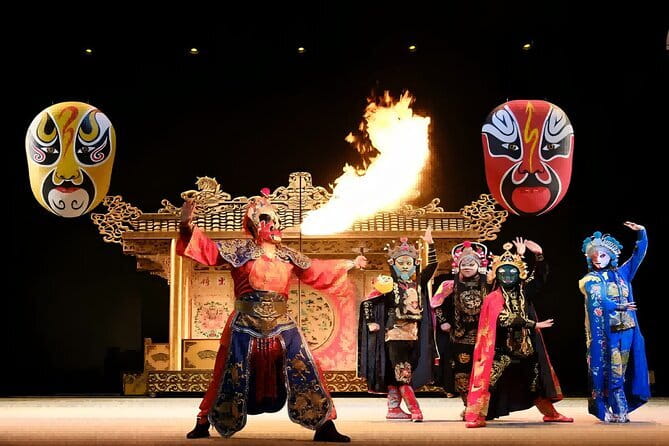
The first listed opera excerpt is The Three Heroes Fight Lü Bu. This is a strong way to open because it introduces the forceful side of Sichuan opera right away.
Expect singing, recitation, movement, and martial arts to work together. The excerpt is not only about vocal performance. It shows how performers use controlled gestures and combat movements to tell a story from the stage.
For you, the value is immediate visual clarity. Even if you do not know the characters or the larger tale, the physical action gives you something to follow. It also prepares you for the later acrobatics and specialty acts.
The limitation is that an excerpt cannot provide the full shape of a long opera. Think of it as a concentrated sample, designed to show the style rather than explain every character.
Hand shadows and umbrella kicking widen the show
Next comes hand shadow art, followed by umbrella kicking. These acts shift the mood from opera drama to visual skill.
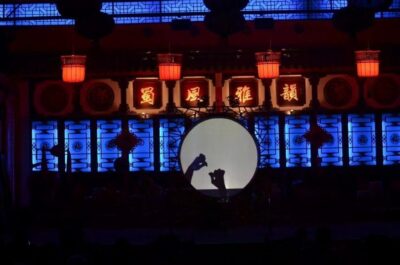
Hand shadows are a simple idea with a surprising effect. The performer uses hands and light to create recognizable forms, giving the program a quiet pause before the more athletic acts. It is a useful reminder that Sichuan stage traditions are not limited to elaborate costumes and loud action.
Umbrella kicking then brings back speed and balance. The act is part of the acrobatic section, and its appeal is easy to understand even without words. The object becomes part of the performer’s timing, coordination, and control.
These two pieces also make the night suitable for mixed-age groups. A child may respond to the hand shadows, while an adult may focus on the precision of the manipulation. The variety keeps the show from feeling like a single repeated trick.
More Live Music in Chengdu:
- Sichuan Culture Opera Show in Chengdu
★ 4.5 · 69 reviews - Chengdu Sichuan Opera Evening Show Ticket-Shu Feng Yan Yun
★ 5.0 · 15 reviews - Chengdu: Sichuan Opera Show ShufengYayun & Covered Bowl Tea
★ 4.2 · 14 reviews - Shu Feng Ya Yun Sichuan Opera Ticket
★ 5.0 · 13 reviews
Hidden Knife and Releasing Pei bring back the opera
The Sichuan opera specialty called Hidden Knife follows the early acrobatics. Its title suggests a dramatic piece built around concealed movement and surprise, fitting the broader style of theatrical revelation that leads toward face-changing.
The program then returns to an opera excerpt, Releasing Pei. These opera sections matter because they prevent the performance from becoming only a collection of circus-style stunts. Singing, recitation, movement, and character work remain part of the evening.
You should expect the narrative sections to be more dependent on cultural context than the acrobatics. If you do not understand every word, focus on gestures, costumes, rhythm, and the performers’ physical expression. The program is designed to offer a broad introduction, not a line-by-line translation lesson.
This balance is one of the show’s better choices. You get enough opera to understand its role, but the program keeps moving toward the crowd-pleasing specialties that many people come to see.
Fire breathing and Rolling Lantern supply the big thrills
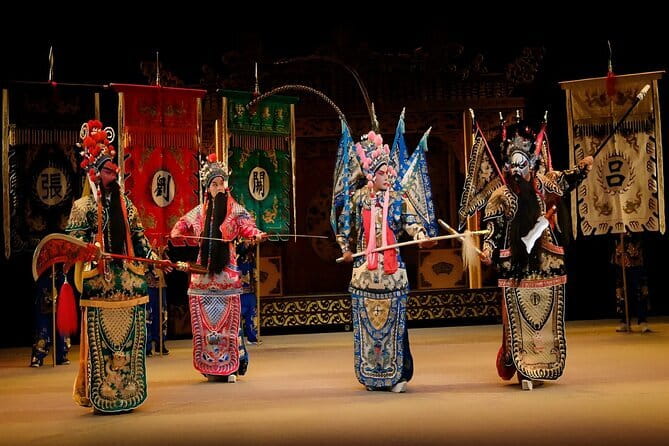
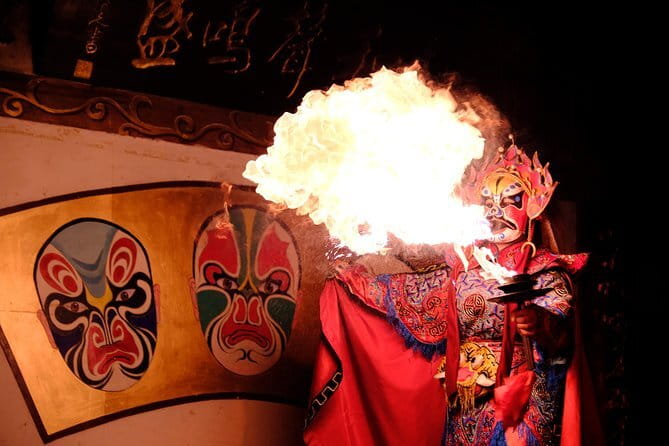
Fire breathing is the first unmistakably high-risk-looking specialty on the program. It gives the evening a sharp burst of danger and spectacle. The effect is brief, but that is part of its power. A concentrated act can make a stronger impression than a long routine that repeats the same idea.
Rolling Lantern follows with another distinctive Sichuan opera specialty. The title points to a performance built around lantern movement and balance, and it is one of the acts that can make the show feel unlike a standard stage concert.
These are likely highlights if you want a lively night out rather than a strictly academic presentation. At the same time, you should remember that the program is a performance, not a behind-the-scenes demonstration. It does not explain the safety work or training behind the acts.
The show’s compact length helps here. Fire breathing and Rolling Lantern arrive before your attention fades, and the program continues into another physical act rather than lingering too long on one effect.
Drum kicking and puppet theater change the rhythm
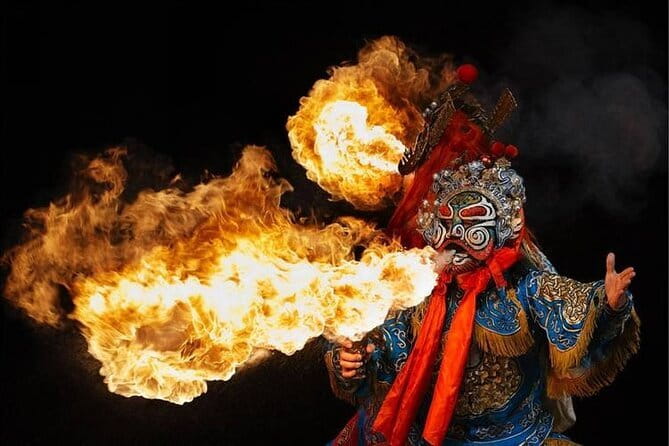
Multi-person drum kicking adds another acrobatic section. The presence of several performers makes this different from the umbrella act. It is less about one person’s control of a single prop and more about coordinated movement, timing, and shared stage space.
After that comes the puppet show The Beauty of Life. This is a welcome change of pace. Puppetry adds another traditional art form while giving your eyes a different kind of movement to follow.
I like this pairing because it keeps the middle of the program from becoming a blur of fast tricks. The drum act provides energy, while the puppet show allows the performance to turn toward storytelling and visual detail.
If you are attending with children, this section may be especially useful. The puppets offer a clear visual focus, while the drum act has the broad physical appeal of an acrobatic routine. Adults who want more opera may find the program’s constant switching slightly less satisfying, but that variety is central to its design.
Face-changing builds toward the eight-face finale
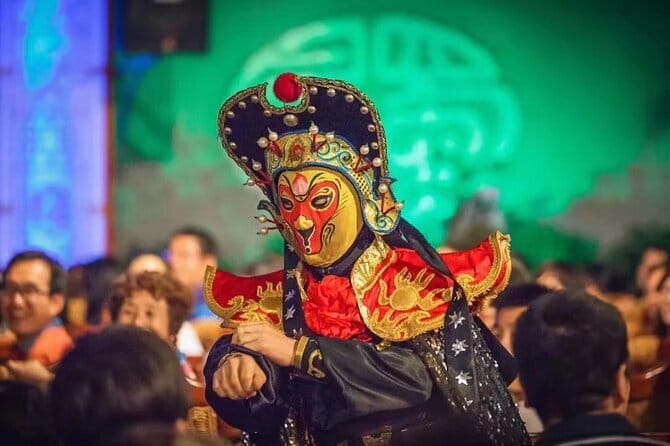
Face-changing is the centerpiece of Sichuan opera for many first-time viewers. Performers alter painted faces with astonishing speed, often using changes in color and design to suggest shifts in character or emotion.
The exact method is part of the mystery. The appeal is not only that the face changes, but that you cannot easily see when or how the change takes place. Watch closely, but do not expect the show to reveal its technique.
The program then presents its exclusive eight-face changing skill. This is the moment that gives the performance its name and its strongest selling point. Instead of treating face-changing as one brief surprise, the show builds to a more elaborate version with eight changes.
You should expect speed and precision rather than a long explanation. The eight-face sequence is best viewed as a demonstration of control, timing, and stagecraft. It also connects directly to Little Sanqing’s struggle to master the art, giving the finale a little more meaning than a stand-alone trick.
This is the part I would use to decide if the show suits you. If you are curious about Sichuan opera’s most famous specialty, the ticket is easy to justify. If face-changing does not interest you, the rest of the program still offers plenty, but the evening is clearly shaped around this art.
Three costume changes and a traditional fashion show
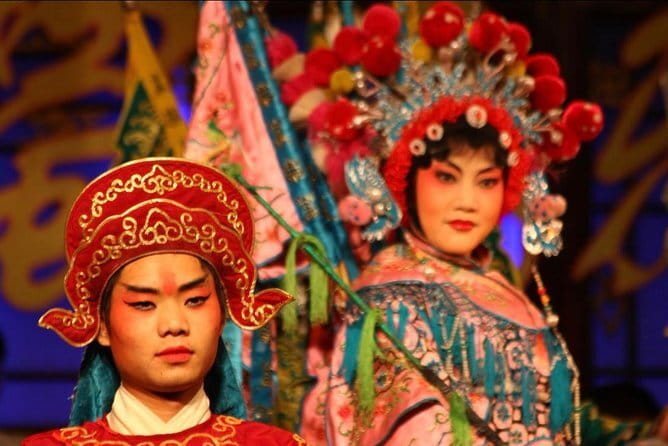
Three costume changes add another kind of transformation. Instead of changing only the face, the performer or performers shift the visual identity of the stage through clothing.
Costume changes are important in Chinese opera because clothing communicates role, status, mood, and period. Even without knowing the conventions, you can see how a new costume changes the way a performer moves and how the audience reads the character.
The traditional fashion show follows naturally. It is an unexpected section for anyone expecting only opera, but it gives you a closer look at the elegance of traditional clothing and design.
The fashion presentation is also a good bridge between theater and everyday cultural display. It may feel less dramatic than fire breathing or face-changing, but it adds visual context. One of the strongest aspects of the full program is this contrast between explosive stage tricks and quieter displays of style.
Water sleeves and ghostly dance close the night
The final dance performances include Water Sleeve Dance and Ghost Immortal Dance. Water sleeves are long, flowing costume extensions that turn arm movements into sweeping lines across the stage.
This style rewards attention to grace rather than speed. After the noise and physical risk of the earlier acts, the sleeve dance gives the ending a more refined mood. It shows that Sichuan stage performance can be delicate as well as dramatic.
Ghost Immortal Dance adds a more supernatural tone. The title suggests a stylized dance built around ghostly or celestial imagery, though the supplied details do not explain the plot or characters. Expect an atmospheric closing piece rather than a practical dance demonstration.
Together, these dances leave you with a broader picture of the art form. You see combat, comedy-like visual tricks, acrobatics, costumes, puppetry, fire, and graceful movement in one short sitting.
Is $18 good value for a Chengdu evening?
At $18, this is strong value if you want several traditional arts in one program. The ticket includes the full performance and a cup of Sichuan gaiwan tea. You are paying for a compact cultural night, not for a long single-act opera.
The price works especially well for first-time visitors who want an introduction without committing to a much longer performance. The program includes the famous face-changing technique, the rarer eight-face sequence, fire breathing, Rolling Lantern, acrobatics, dance, and opera excerpts.
The value is less clear if you want a serious study of one discipline. You will not spend 70 minutes on only face-changing, classical singing, or puppet theater. The program’s strength is range.
I would also count the location and timing in the value. An 8pm start near public transportation makes it easy to fit into a Chengdu itinerary. The exact theater address is provided, which helps you avoid a last-minute search in an unfamiliar part of the city.
Who should book this performance?
I would recommend it for families, solo visitors, couples, and friends who want a memorable evening with strong visual variety. It suits you particularly well if you have little background in Chinese opera and want the clearest, most entertaining entry point.
It is also a good choice for anyone who has already seen a basic face-changing act and wants a fuller program. The eight-face technique, costume changes, puppetry, and traditional dances give the night more range than a single specialty show.
You may want to choose something else if your priority is a full-length opera with detailed subtitles, extended character development, or a slow look at musical structure. Those details are not provided here, and the quick program suggests a showcase format.
Most people can participate, and the theater is near public transportation. Keep in mind that the booking terms require cancellation at least 24 hours before the 8pm start for a full refund. Changes made within 24 hours are not accepted, and the performance may be rescheduled or refunded if poor weather or an insufficient number of bookings causes cancellation.
My booking verdict for Jinjiang Theater
Book this show if you want an affordable, easy evening that introduces you to the most eye-catching sides of Sichuan opera. The strongest reasons are the eight-face changing finale, the fire breathing and Rolling Lantern acts, and the rare chance to see opera, puppetry, acrobatics, costume display, and dance together.
I would not book it expecting a quiet, scholarly theater study. I would book it expecting a fast-moving cultural sampler with a clear centerpiece, a useful central location, and enough variety to keep your attention from the first fight scene to the final sleeve dance.
FAQ
Where does the Sichuan opera show take place?
The performance takes place at Jinjiang Theater, 54 Hua Xing Zheng Jie, Luomashi, Jin Jiang Qu, Chengdu, Sichuan, China, 610017.
What time does the show begin?
The listed start time is 8pm.
How long does the performance last?
The performance lasts approximately 1 hour and 10 minutes.
What is included with the admission ticket?
Admission to the full Jinjiang Theater performance is included. You also receive a complimentary cup of traditional Sichuan gaiwan tea.
What acts are included in the program?
The program includes opera excerpts, hand shadow art, umbrella kicking, Hidden Knife, fire breathing, Rolling Lantern, multi-person drum kicking, puppetry, face-changing, eight-face changing, three costume changes, a traditional fashion show, Water Sleeve Dance, and Ghost Immortal Dance.
Is the theater close to public transportation?
Yes. Jinjiang Theater is described as being near public transportation and near Tianfu Square.
Can I cancel for a full refund?
Yes, if you cancel at least 24 hours before the experience start time. Cancellations made less than 24 hours in advance are not refunded, and changes within that period are not accepted.
What happens if the performance is canceled?
If poor weather or an insufficient number of bookings causes cancellation, you will be offered another date or experience, or a full refund.
Just added to the listings in Chengdu
- Classsic sichuan Opera at sichuan Provincial Theater★ 5.0 · 4 reviews
- Shu Feng Ya Yun Sichuan Opera Ticket★ 5.0 · 13 reviews
- Sichuan Opera Show with Hotel Pickup★ 5.0 · 3 reviews
- Skip the Line: Sichuan Opera Chengdu Ticket★ 4.0 · 8 reviews
- Sichuan Opera with face-changing at Sichuan opera theater★ 4.5 · 6 reviews
- Chengdu Signature Opera Face Changing and Tea★ 5.0 · 7 reviews
- Chengdu Sichuan Opera Evening Show Ticket-Shu Feng Yan Yun★ 5.0 · 15 reviews
- Jinjiang Theater:Eight-Face Changing-Legendary Sichuan Opera★ 4.0 · 6 reviews
Chinese Opera Shows, compared.
Sichuan Opera Shu Feng Yan Yun Evening Show Ticket
Read our review →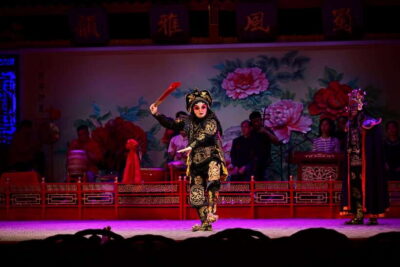
Chengdu Sichuan Opera Show Ticket – Shu Feng Ya Yun
Read our review →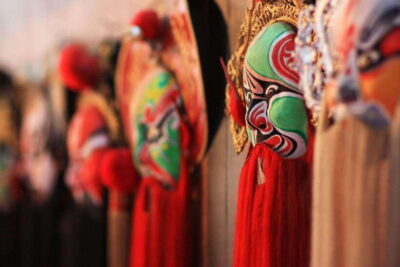
Traditional Cultural Show Peking Opera Tickets
Read our review →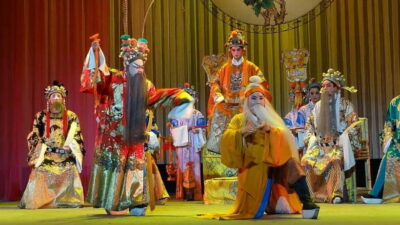
Beijing LiYuan Theatre VIP Seats Opera Show with Private Transfer Service
Read our review →Sichuan Opera Show Ticket – Shu Feng Ya Yun
Read our review →
Chengdu Sichuan Opera Evening Show Ticket-Shu Feng Yan Yun
Read our review →Browse the lists this tour appears in