
REVIEW · FRANCE
Area ,Opera, Jewellery,Fashion,Palais Royal walking tour
Paris’s luxury side comes into focus on this compact walk from Palais Royal to Opéra Garnier. You move past grand façades, famous jewelry houses, fashion boutiques, old theaters, a large church, and a small perfume museum. It is less a standard sightseeing march and more a guided look at how style, commerce, and power shaped this corner of the Right Bank.
I like the small advertised group size of five, which gives you room to ask questions. I also like the subject matter: Place Vendôme and Rue Saint-Honoré tell a different Paris story than the Eiffel Tower or Notre-Dame. The main drawback is that the tour stays outside the opera house, so you must pay an additional €14 if you want to visit inside.
The guide, Neda, is praised for her warmth, humor, and ability to connect fashion, business, architecture, and French culture. Still, this tour depends heavily on her delivery. One poor experience described a guide who was hard to hear and offered little beyond the basic facts, so stand close, ask questions, and make sure this style of tour matches what you want.
Key points at a glance
- Palais Royal begins the story: See an elegant garden commissioned near the Louvre so a powerful minister could remain close to the king.
- Luxury Paris takes center stage: Rue Saint-Honoré and Place Vendôme bring fashion, jewelry, and high-end commerce into the walk.
- The route mixes glamour with substance: Molière, the Comédie-Française, Saint-Roch Church, Napoleon, and Haussmann-era Paris all enter the conversation.
- Palais Garnier is the grand finale: The exterior is included, while entry to the opera house costs an extra €14.
- The Musée du Parfum adds a sensory stop: Ancient bottles and perfume tools give context to a familiar French luxury product.
- A short, focused format: At about 2 hours 10 minutes, it works well as a morning introduction to the Opéra district.
A fashionable start at Palais Royal
Meet at Le Nemours, at 2 Place Colette, at 10 a.m. The meeting point is near Palais Royal and public transportation, putting you in a useful central location from the first minute.
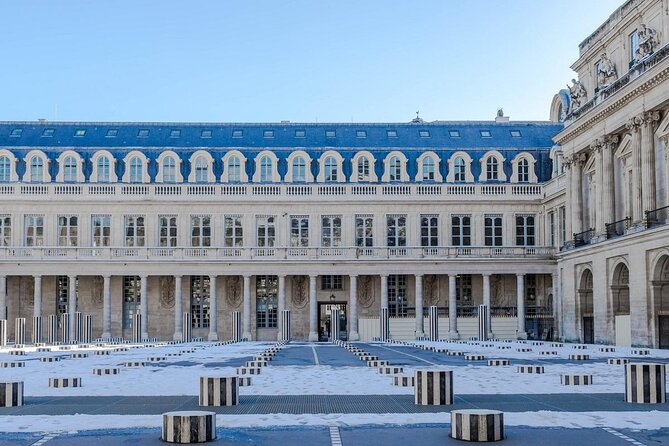
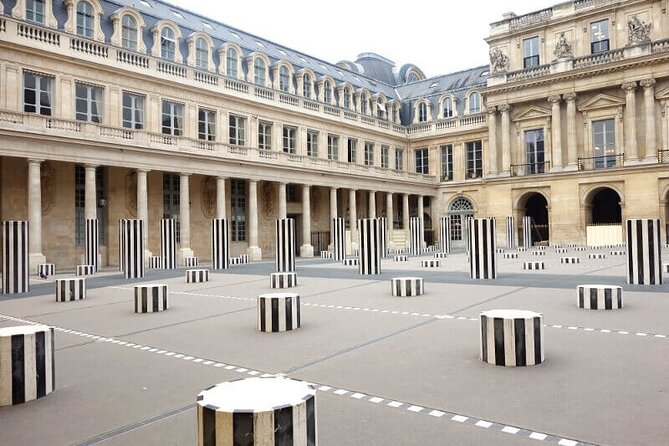
The first stop is the Jardin du Palais Royal, where you spend about 20 minutes. The garden grew from the Palace of the Cardinal de Richelieu, ordered in 1633 close to the Louvre. At that time, the Louvre served as a royal residence, and Richelieu wanted to remain near the king.
That detail gives the opening stop more bite than a simple garden visit. You are looking at a place tied to royal access, political influence, and the careful positioning of power in central Paris. Today, the garden sits among government and cultural buildings, including the Constitutional Council, the Ministry of Culture and Communication, and the Comédie-Française.
The stop is free, and the pace should feel relaxed. You are not being rushed through a long list of monuments. Instead, this is a chance to get your bearings and ask Neda what else to see in Paris. If you enjoy architecture and city stories more than checking off sights, this opening works well.
More Live Music in Paris:
- Paris: 3-Course-Dinner Cruise on the Seine with live music
★ 4.7 · 7,248 reviews - Paris: 4-Course Dinner Cruise on Seine River with Live Music
★ 4.5 · 3,827 reviews - Paris: Gourmet Dinner Cruise on Seine River with Live Music
★ 4.5 · 2,531 reviews
Molière and France’s oldest active theater company
The walk then pauses for about five minutes at the Comédie-Française. That is a short stop, but the subject is important: Molière and the place his work holds in French culture.
Molière’s plays have been translated into every major living language, and the Comédie-Française has performed his works more often than those of any other playwright. The theater company is the oldest active theater company in the world, giving this stretch of Paris a strong connection to live performance.
You will not spend a long period inside the theater on this tour, and the stop is listed as free. The value comes from the explanation. A good guide can help you see the Comédie-Française as more than a handsome building. It becomes part of France’s long theatrical tradition and a useful link between literature, public life, and Parisian culture.
Neda’s strongest quality, based on the information available about her guiding style, is her ability to make these connections personal. She has been praised for bringing subjects studied in books into the streets. That approach is useful here, because Molière can feel distant until a guide ties him to a real institution and a real Paris neighborhood.
Rue Saint-Honoré, where luxury becomes street life
About 25 minutes are devoted to Rue Saint-Honoré, one of the route’s most revealing sections. The street runs roughly 1,840 meters from central Paris toward the prestigious 8th arrondissement. Its long stretch combines historic sites, cultural landmarks, artistic details, and luxury shops.
This is where the tour’s fashion focus becomes clear. You pass Haussmann-style stone façades and boutiques that give the street its polished look. The attraction is not simply window-shopping. The guide explains how this part of Paris developed into a center for fashion, business, and high-end retail.
I like this section because it asks you to look at a working city rather than a single monument. The buildings provide the setting, but the shops show how Paris presents itself today. You can ask Neda about brands, French style, local recommendations, or places worth returning to after the tour.
Keep your expectations sensible. The walk does not promise shopping discounts, private access to ateliers, or entry into luxury stores. It is an outdoor introduction to the area and its character. If you want to understand why this district feels so different from a neighborhood market street, this is the right part of the route. If you want a dedicated shopping trip, you will need more time afterward.
Saint-Roch Church and the layers of Paris
The next stop is Église Saint-Roch, with about 15 minutes to take in the building and its background. At 126 meters long, it is one of the largest churches in Paris. Its plan was inspired by Notre-Dame-de-Paris, but its long construction period produced a mix of classical and baroque styles.
That mixture matters. Paris is often presented as a city of unified beauty, but many of its buildings are the result of long projects, changing tastes, and shifting periods of construction. Saint-Roch gives you a quick lesson in that process.
The stop also provides a useful change of mood. After the polished boutiques of Rue Saint-Honoré, the church brings the walk back to religion, architecture, and older public institutions. The tour does not list an admission charge here. The emphasis is on learning about the structure and its place along the route.
Because only 15 minutes are planned, you should not expect an extended church visit. If you are especially interested in sacred art or interior details, note anything you want to revisit on your own. The walk is designed to give you a broad picture, not to spend an hour at every landmark.
Another night with a band on stage:
- Paris: Opera Garnier and Seine River Cruise Tickets
★ 4.5 · 957 reviews - Paris: Classical Music Concert in Saint-Julien-le-Pauvre
★ 4.8 · 791 reviews - Paris: Seine River Cruise with 3-Course Dinner & Live Music
★ 4.5 · 570 reviews - Paris: Classical Music Concert Tickets in Parisian Churches
★ 4.7 · 405 reviews
Place Vendôme and the business of jewelry
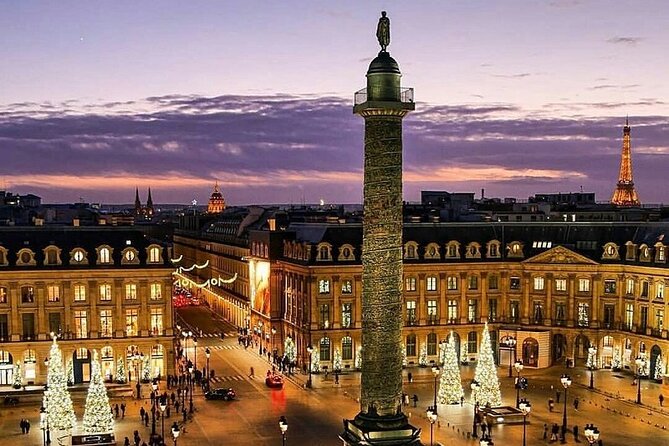
Place Vendôme receives about 20 minutes, and this is likely the clearest stop for anyone interested in jewelry. The square was laid out in 1702 as a monument to the armies of Louis XIV, known as the Sun King. Later, the original monument was replaced by the Vendôme Column, modeled on Trajan’s Column in Rome.
The column commemorates Napoleon Bonaparte’s victory at Austerlitz in 1805. That change tells you a great deal about Paris. Public spaces could be redesigned to honor a new ruler, a new military success, or a new political message.
Today, Place Vendôme is famous for luxury jewelry boutiques. The square’s broad proportions and carefully arranged façades create an impressive setting for those businesses. You can look at the architecture, learn how the square gained its present reputation, and ask questions about the jewelry district.
This is an especially good stop if you want to understand the connection between French prestige and place. Jewelry here is not presented as an isolated product. It is part of a larger system involving royal symbolism, imperial ambition, architecture, branding, and Parisian style.
You should also remember that this is an orientation stop, not a private jewelry appointment. The tour does not include purchases, store access, or special shopping privileges. Its value is in showing you where this side of Paris operates and giving you a guide who can point out what deserves a closer look.
Palais Garnier, the grand architectural finish

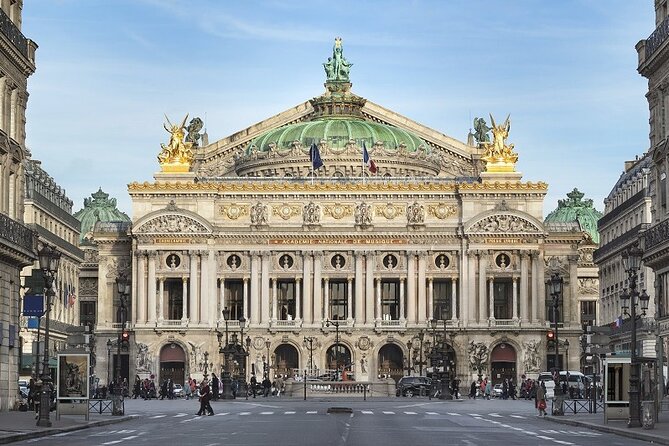
The walk reaches Palais Garnier for about 25 minutes. This is the visual high point of the tour, with the grand Paris Opera House commissioned by Emperor Napoleon III as part of his rebuilding of Paris.
A competition for the design took place in 1860. The finished opera house became a major center for opera and ballet, and its name is closely tied to Parisian glamour. Even from the outside, the building gives the route a strong finish after the smaller stories of shops, churches, and theaters.
The tour includes an explanation of the building, but not the interior visit. Entry costs €14 separately. That distinction matters when you compare this walk with a full opera-house tour. You get the exterior and the guide’s interpretation as part of the experience, then decide if the inside deserves extra time and money.
I would not book this tour assuming the guide will spend a long time discussing every room inside Palais Garnier. The published schedule allows about 25 minutes here, and the interior is not included. If the opera house is your main reason for coming, plan carefully and check whether you want to add the €14 visit.
On the other hand, the exterior stop works well as the endpoint of a route about power, style, and public display. Richelieu’s palace, Molière’s theater, Rue Saint-Honoré, Place Vendôme, and Napoleon’s opera house all show different forms of influence. The opera is a fitting last chapter.
Perfume bottles and the final stop
The Musée du Parfum, operated by Fragonard, receives about 15 minutes. Located close to Palais Garnier, it offers a short look at how perfume became a famous luxury product and an everyday part of life.
The collection includes bottles and perfume-related objects from ancient Egypt through the 20th century. Items include kohl pots, pomanders, vinaigrettes, perfume burners, pot-pourris, travel sets, smelling-salt bottles, and decorative flasks.
This stop broadens the tour beyond clothing and jewelry. Perfume is another way Paris connects craft, design, personal style, and commerce. The museum also gives you something concrete to look at after the larger urban views of squares and façades.
Fifteen minutes is enough for an introduction, not a full museum visit. If you become interested in perfume history, you may want to return with more time. As part of the walking route, though, it offers a neat closing note and keeps the experience from becoming only a parade of luxury storefronts.
What the $74.49 price gets you
At $74.49 per person, this is not the cheapest way to walk from Palais Royal to Opéra. You can cover much of the route on your own for the cost of a metro ticket and your own planning.
The price makes more sense if you want interpretation rather than directions. You are paying for an English-speaking guide, a planned route, historical context, and the chance to ask questions as you go. The advertised maximum of five people should also make conversation easier than on a large group outing.
The strongest value comes when Neda is active and engaging. Her reported strengths include warmth, humor, practical help, and the ability to link architecture with fashion, business, and French culture. That can turn familiar streets into a clearer story.
The value drops if you want long visits inside monuments or detailed museum time. No major admission is included, and the Palais Garnier interior costs another €14. You should also know that the tour can feel light on information if the guide is hard to hear or speaks only briefly at the stops. Stay near the guide and ask for clarification if needed.
Who should book this walk
I would recommend it for a first visit to Paris if you want an introduction to the Opéra and Right Bank districts without spending half a day in a museum. It also suits anyone drawn to fashion, jewelry, perfume, theater, architecture, or the social history of luxury.
The small-group setup is helpful for solo visitors, couples, and curious families with older children. Most people can participate, and the route is near public transportation. The 10 a.m. start leaves the rest of your day open for the Louvre, shopping, another museum, or a longer visit to Palais Garnier.
I would choose another tour if your priority is the interior of the opera house, a detailed art history lecture, or a shopping service with store appointments. This walk gives you a broad, street-level introduction. Its appeal depends on the guide’s storytelling and on your interest in the mix of old Paris and modern luxury.
Free cancellation is available if you cancel at least 24 hours before the start time. Changes or cancellations made within that final 24-hour period are not accepted for a refund.
Should you book the Palais Royal to Opéra walk?
Book it if you want to understand why this part of Paris is linked with fashion, jewelry, theater, perfume, royal power, and imperial ambition. The route is short enough to fit into a busy day, yet varied enough to avoid feeling like one long parade of shop windows.
I especially like the combination of Place Vendôme, Palais Garnier, and the Musée du Parfum. Those stops give you three views of Parisian luxury: public grandeur, private adornment, and personal scent. Add the Comédie-Française and Saint-Roch Church, and the walk becomes more than a shopping district tour.
Go in with the right expectations. You are buying a guided outdoor overview, not admission to every landmark. If you want a friendly guide who can connect the streets to French culture and answer questions, this small-group format is a sensible choice. If you need a tightly scripted lecture with plenty of time at each stop, confirm the tour’s style before booking.
FAQ
How long does the tour last?
The walking tour lasts approximately 2 hours and 10 minutes.
What time does the tour start?
The tour starts at 10 a.m.
Where does the tour begin?
It begins at Le Nemours, 2 Place Colette, 75001 Paris, France.
Where does the tour end?
The tour ends at Palais Garnier, Place de l’Opéra, 75009 Paris, France.
Is entry to Palais Garnier included?
No. The walking tour covers the opera house from the outside. An interior visit costs €14 and is not included.
How many people can join the tour?
The activity has a maximum of five travelers.
Is the tour offered in English?
Yes. The tour is offered in English, and a mobile ticket is provided.
Just added to the listings in Paris
- Create unique jewelry from top Parisian designer Bijoux Blues★ 4.0 · 2 reviews
- Opera Garnier with private guide★ 4.5 · 21 reviews
- Paris Opera Garnier Private Tour★ 5.0 · 42 reviews
- Sunset Picnic with View of Eiffel Tower and Live Music★ 5.0 · 15 reviews
- Private Opera Garnier Theater 2-Hour Tour in Paris★ 5.0 · 45 reviews
- Opera Garnier Mysteries Private Guided Tour with Skip-the-Line Entrance★ 5.0 · 49 reviews
- 2 Hour Private Opera Garnier Guided Tour★ 5.0 · 11 reviews
- Harlem in Paris : the Birth of Jazz in France (Small Group Walking Tour)★ 5.0 · 37 reviews
Live Music, compared.
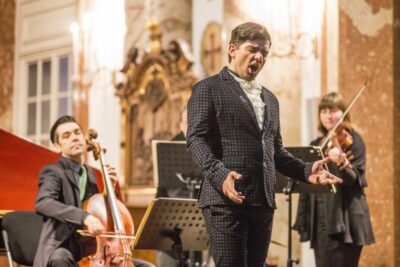
Vivaldi’s Four Seasons Concert in Karlskirche
Read our review →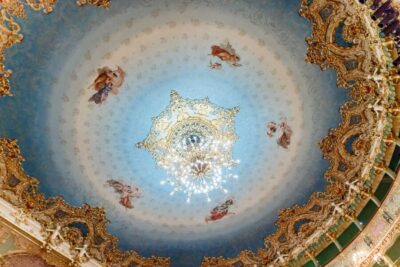
La Fenice Opera House Entry Ticket with Audio Guide
Read our review →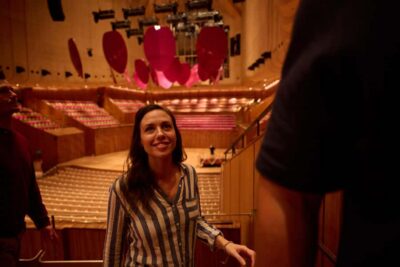
Opera House Guided Tour with Entrance Ticket
Read our review →
New Orleans Steamboat Natchez Jazz Cruise with Dinner Option
Read our review →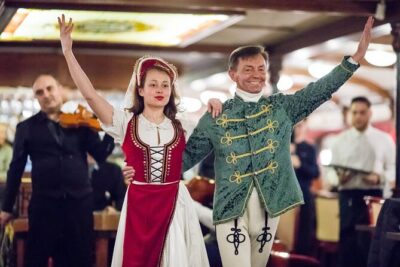
Budapest Danube Cruise and Dinner Options, Live Music and Dance
Read our review →
3-Course-Dinner Cruise on the Seine with live music
Read our review →
Classical Concert in the World-Famous Musikverein
Read our review →
Browse the lists this tour appears in