
REVIEW · JAPAN
Traditional Japanese Music show & Experience Tour in Osaka
A shamisen’s sharp, lively notes, the ringing sound of the koto, and the deep thump of a wadaiko come together in this one-hour Osaka music experience. You listen first, then pick up the instruments yourself. That hands-on change from audience member to participant is the main reason to consider it.
I like the small maximum group of seven, which should make it easier to see the instruments and ask questions. I also like the generous 25-minute playing session. You get more than a quick photo opportunity, though you should know the concert content changes by day, so the exact program is not fixed.
The main drawback is the limited schedule: Wednesday at 11:00 or Friday at 18:30. The activity also needs at least two participants to run, so a last-minute booking carries some uncertainty, although a cancellation for that reason comes with a choice of another date or a full refund.
Key points to know before booking
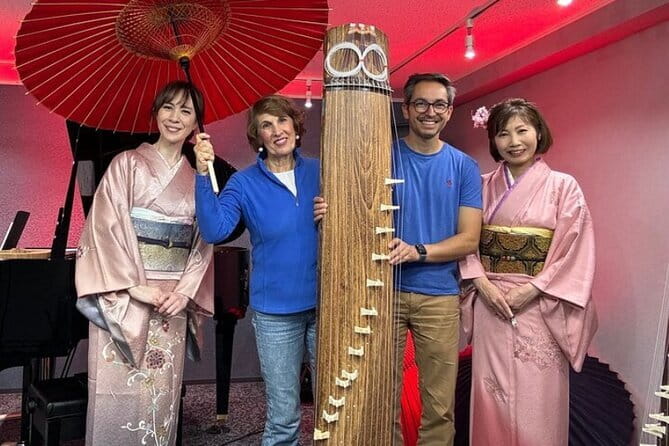
- You hear three major Japanese instruments: The program may include shamisen, koto, wadaiko, and other traditional instruments.
- You play the instruments yourself: Twenty-five minutes are set aside for hands-on practice with a Japanese instrument.
- The group stays small: No more than seven people can join, creating a quieter setting for questions and photos.
- The format is easy to follow: The hour is divided into a 25-minute concert, 25-minute practice session, and 10 minutes for photos.
- The schedule is narrow: Sessions run Wednesday at 11:00 and Friday at 18:30.
- The price is $46.12 per person: That is fair if you value instruction and participation, not just a short performance.
Why this Osaka music experience is different
Many cultural activities ask you to watch. This one asks you to listen, handle, and play. That simple difference gives the hour a useful shape: first you hear what trained musicians can do, then you get a chance to understand the instruments through your own hands.
The session focuses on hogaku, the broad term used for traditional Japanese music. You are not simply being shown an instrument behind glass. You can ask the professional musicians questions and take photos while holding the instruments at the end.
That makes this a good choice if you want a cultural activity that fits into a busy Osaka day. At roughly 60 minutes, it is short enough to place between sightseeing stops, yet long enough to provide more substance than a quick demonstration.
The tone should suit curious beginners. You do not need to arrive as a music expert, and the activity is designed around explanation and participation. The available information does not promise a formal lesson or a polished performance workshop, so I would treat the playing section as an introduction rather than serious musical training.
More Live Music in Japan:
- Kyoto: Traditional Concert at Townhouse or Bathhouse
★ 4.9 · 224 reviews - Experience the Asakusa Kabuki Opera Show!
★ 5.0 · 99 reviews - Japanese Traditional Music Show in Tokyo
★ 5.0 · 72 reviews
The 25-minute concert: hear the instruments in context
The first part is a 25-minute live concert by professional musicians. This is the best time to sit back and listen closely, since you will have plenty of opportunity to try the instruments later.
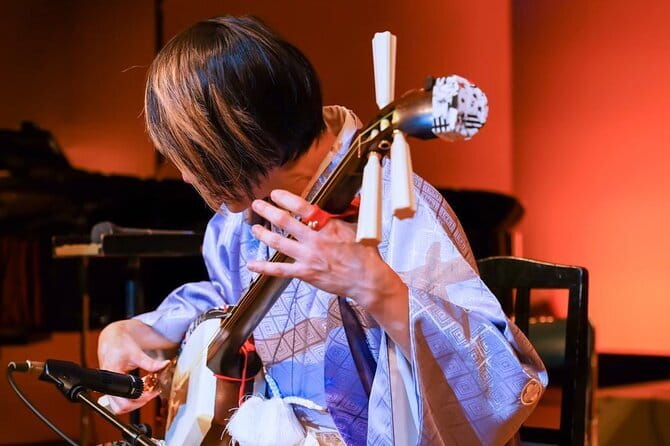
The shamisen is a Japanese lute with a distinctive, bright sound. Its appearance and tone are easy to recognize once you have heard it live, and seeing a musician play it at close range can help you notice how much control is needed to produce each note.
The koto is described here as a Japanese harp. Its long body and plucked strings create a different sound from the shamisen. Hearing the two in the same session gives you a useful point of comparison: one is more rhythmic and direct, while the other can sound lighter and more flowing. The precise musical effect depends on the day’s program.
Then there is the wadaiko, the traditional Japanese drum. It brings physical force to the performance, with a deep tone that feels very different from the string instruments. If you have limited time in Japan and want to hear several types of traditional music in one sitting, this variety is a strong feature.
The concert is not identical every time. The content changes according to the day, which means you should not book expecting a precisely fixed set list. That is a small inconvenience for anyone planning around one particular instrument, but it also gives the experience some freshness.
The 25-minute instrument session: from watching to playing
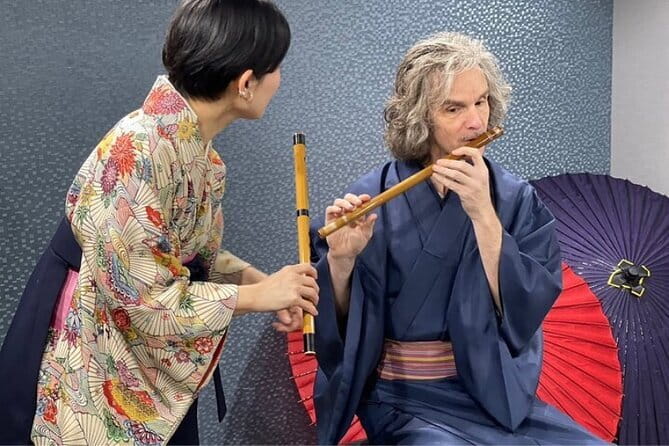
After the concert, you spend 25 minutes trying traditional Japanese musical instruments. This is the heart of the activity for many people.
The available details do not specify which instrument each participant will play or how the session is assigned. You should therefore expect to work with an instrument provided for the experience, rather than assume you will receive a full lesson on the shamisen, koto, or wadaiko.
Still, 25 minutes is a useful amount of time. A short demonstration followed by a single turn can feel rushed. Here, you have room to get a basic feel for the instrument, ask questions, and try again. That matters most with instruments that use unfamiliar hand positions or playing methods.
I especially like that questions are welcome throughout the activity. You can ask the musicians about the sound, how the instruments are played, or what you are holding. Since the group is capped at seven, there should be a better chance of getting an answer without the session turning into a crowded class.
Keep your expectations sensible. This is not advertised as a private lesson, and the total session lasts only an hour. You are unlikely to master a traditional instrument in one visit. The value is in making the music less abstract and gaining a personal sense of how the instrument works.
For children or first-time cultural visitors, this section may be more memorable than the concert alone. For adults, it offers an easy way to take part without committing to a longer class.
The final 10 minutes: questions and photos
The last 10 minutes are reserved for photos with the instruments and performers. This gives the experience a clear ending and lets you keep a visual reminder of the activity.
Photos are not the main reason I would book this tour, but they are a useful extra. Traditional instruments can be difficult to see up close in other settings, and holding one helps you remember the shape, size, and feel of it.
You should follow the performers’ directions when handling the instruments. The information confirms that you can take photos holding them, but it does not describe the exact photography rules or whether every instrument will be available for every person.
The final question period also helps if something caught your attention during the concert. You can use those minutes to ask about a sound you heard or an instrument you played. Ten minutes is not a long time, so think of your questions during the performance rather than waiting until the last moment.
Another night with a band on stage:
- Traditional Japanese Music show & Experience Tour in Kyoto
★ 5.0 · 57 reviews - Concerts Played with Traditional Instruments in Kyoto
★ 5.0 · 50 reviews - Kyoto: Japanese Koto & Shamisen Concert and Koto Class
★ 4.9 · 31 reviews - Tokyo: Traditional Asakusa Music Show with Dinner
★ 5.0 · 10 reviews
What the small group means for your visit
The maximum group size is seven people. That is one of the most useful details here because traditional instruments are best understood at close range. A smaller room and a limited audience should make it easier to watch the musicians’ hands and hear explanations.
A small group can also make the hands-on part feel less awkward. You are not being asked to perform before a large audience. You are taking part in a guided cultural activity where beginners are expected.
The tradeoff is that the experience requires at least two participants to operate. If the minimum is not reached, the provider may offer another date or experience, or provide a full refund. If your Osaka schedule is tight, keep that condition in mind before building an important evening around the Friday session.
The activity is suitable for most people, and service animals are allowed. It is near public transportation, but private transportation is not included. You will need to make your own way to the meeting point and return from there after the activity.
Choosing between the Wednesday and Friday sessions
There are two listed departures:
- Wednesday at 11:00
- Friday at 18:30
The Wednesday session works well if you want to place music early in your day. Afterward, you still have time for other plans in Osaka. The catch is that a morning activity may compete with sightseeing priorities, especially if you have a packed itinerary.
The Friday evening session offers a different rhythm. You can spend the day exploring and use the music program as an evening cultural stop. At 18:30, it could fit neatly before or after dinner, though the activity itself lasts only about an hour and does not include food or transportation.
The best choice depends on your schedule rather than on a different advertised format. The content can vary by day, so you should not assume the Wednesday and Friday programs will be identical.
Meeting in Minamisenba, Osaka
The meeting point is Alpha Shinsaibashi, at 3-chōme-5-27 Minamisenba, Chuo Ward, Osaka, 542-0081, Japan. The activity ends back at the same meeting point.
This is helpful for planning because you do not have to arrange a complicated one-way transfer after the music session. At the same time, private transportation is not included, so allow enough time to reach the address on your own.
The activity is near public transportation, which makes it a practical addition to a day in central Osaka. You should still check the exact route and allow time to find the building. The supplied details do not identify a specific station, entrance, floor, or landmark, so do not rely on a last-minute arrival without checking your booking confirmation.
A mobile ticket is provided, and confirmation is received when you book. Keep the ticket easy to access on your phone, particularly if you are moving between sightseeing stops.
Is $46.12 a fair price?
At $46.12 per person, this is not the cheapest way to hear Japanese music. You are paying for a compact cultural program rather than a long concert. The price becomes more reasonable because the package combines three things: a live performance, hands-on instrument time, and photos with the musicians and instruments.
If you only want to sit and listen, a separate concert might offer more music for your money. But if you want to play a traditional instrument and ask questions, this format gives you more contact than a standard performance.
The group limit also matters. A seven-person maximum is small enough to support personal attention, though the tour does not promise private instruction. I would call it good value for a first introduction, especially if you are interested in Japanese culture but do not want to spend half a day in a formal class.
The experience is also easy to fit into an itinerary. One hour means you are not giving up a whole morning or evening. That compact design is part of its value for people visiting Osaka on a short trip.
Who should book this experience?
I would recommend it to first-time visitors who want a direct cultural activity, families looking for something more active than sightseeing, and music lovers curious about instruments they may not encounter elsewhere.
It also suits solo visitors. The activity accepts individual bookings, although at least two participants are needed for it to run. One past participant enjoyed attending alone and still found the chance to hear and play the instruments rewarding, so you do not need to bring a group of friends.
This is a good pick if you enjoy asking questions and trying things yourself. It is less suitable if you want a long, formal concert, a guaranteed appearance by one specific musician, or a fixed program built around one instrument.
The activity may also work well for anyone who has already seen Japanese cultural performances but wants a closer look at how the instruments are handled. The playing session gives you a more physical connection to the music without demanding prior skill.
A few practical limits to keep in mind
The schedule is the biggest limitation. With only two weekly departures, you may need to plan around the activity rather than fit it in at the last minute. It is booked, on average, 31 days ahead, so early planning makes sense if the Wednesday or Friday timing is important to you.
The concert content varies by day. That is worth repeating if you have your heart set on one instrument. Shamisen, koto, wadaiko, and other instruments are part of the possible mix, but the exact lineup is not fixed.
The activity has free cancellation up to 24 hours before the start time. Cancellations made within 24 hours are not refunded, and changes during that period are not accepted. Cutoff times use Osaka local time.
Those terms are fairly flexible for a scheduled cultural activity, but the minimum-participant rule adds one more thing to watch. If the provider cancels because too few people have booked, you can choose another date or experience, or receive a full refund.
Should you book the Osaka traditional music experience?
Book it if you want a short, hands-on introduction to Japanese music rather than a passive show. The blend of shamisen, koto, wadaiko, questions, and instrument practice gives the hour a clear purpose, and the small group makes the format more personal.
I would skip it if your schedule cannot handle the fixed Wednesday and Friday times, or if you need a guaranteed instrument lineup. For most curious visitors, though, $46.12 is a fair price for hearing professional musicians and then trying the instruments yourself. It is a focused Osaka activity with genuine participation, not just another photo stop.
FAQ
How long does the traditional Japanese music experience last?
The total duration is approximately one hour. It includes a 25-minute concert, 25 minutes of playing traditional instruments, and 10 minutes for photos.
What instruments might I see or play?
The experience can include shamisen, koto, wadaiko, and other traditional Japanese instruments. The concert content varies depending on the day.
Do I get to play an instrument myself?
Yes. Twenty-five minutes are set aside for trying traditional Japanese musical instruments, and an instrument for the experience is included.
Can I ask the musicians questions?
Yes. You can ask the professional musicians questions during the activity.
Can I take photos with the instruments?
Yes. The final 10 minutes are set aside for photos with the instruments and performers.
What days and times is the activity available?
The listed sessions are Wednesday at 11:00 and Friday at 18:30.
Where does the activity meet?
The meeting point is Alpha Shinsaibashi, 3-chōme-5-27 Minamisenba, Chuo Ward, Osaka, 542-0081, Japan. The activity ends at the same meeting point.
How many people can join?
The maximum group size is seven people. At least two participants are required for the activity to operate.
Can I cancel for a refund?
You can cancel at least 24 hours before the start time for a full refund. Cancellations or changes made less than 24 hours before the start time are not refunded or accepted.
Just added to the listings in Japan
- Japanaese tradtional Tsugaru Shamisen music lesson in Tokyo★ 4.5 · 3 reviews
- Tsugaru shamisen performance over traditional dinner★ 5.0 · 9 reviews
- Easy for everyone! Now you can play handmade mini shamisen and show off to everyone! Musical instruments, sweets and live music★ 5.0 · 3 reviews
- Traditional Concert in Public bath near Kyoto Station★ 5.0 · 5 reviews
- Private Japanese music concert★ 5.0 · 4 reviews
- Kyoto: Matcha & Traditional Japanese Music Immersive Experience★ 5.0 · 9 reviews
- Kyoto: Kujo-yu Sento Traditional Japanese Instrument Concert★ 5.0 · 2 reviews
- Echoes of Peace – A Soul-Stirring Koto Concert in Hiroshima★ 4.5 · 5 reviews
Live Music, compared.

Vivaldi’s Four Seasons Concert in Karlskirche
Read our review →
La Fenice Opera House Entry Ticket with Audio Guide
Read our review →
Opera House Guided Tour with Entrance Ticket
Read our review →
New Orleans Steamboat Natchez Jazz Cruise with Dinner Option
Read our review →
Budapest Danube Cruise and Dinner Options, Live Music and Dance
Read our review →
3-Course-Dinner Cruise on the Seine with live music
Read our review →
Classical Concert in the World-Famous Musikverein
Read our review →
Browse the lists this tour appears in